


.svg)

Large-format mechanical bundle, motors and controller not included
Use with Easel Pro →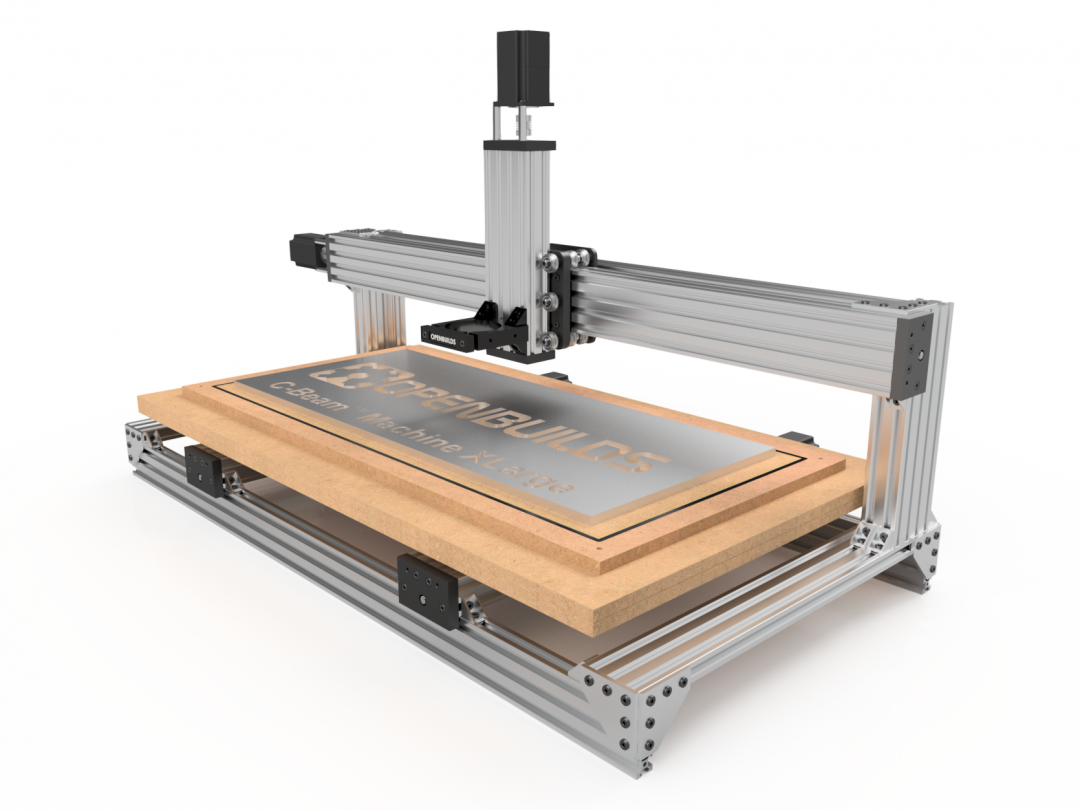
Openbuilds has shut down and no longer sells this model, but it remains fully supported in Easel for existing owners. The C-Beam Machine XLarge was sold as a mechanical bundle with a 750 x 330 mm (29.5 x 13 in) X/Y cut area and Z working height over 2 in (usable depth roughly 25mm as a ballpark, per OpenBuilds), driven by Acme lead screws on X/Y with an anti-backlash nut block on Z. Motors, a controller, and a spindle were not included: the bundle came as parts only, with driver-board and spindle choice left to the builder.
Every cut starts with one formula: Feed Rate = Spindle Speed (RPM) x Chip Load x Number of Cutting Edges (flutes). Chip load is the thickness of material each cutting edge removes in one revolution of the bit. This number comes from the manufacturer of the bit, which publishes a chip-load chart for each bit diameter and material. Look up your exact bit and material, start from the middle of the published range, and you have the third number in the formula. The chart below shows the recommended spindle speed for each material and bit type.
The C-Beam Machine XLarge was sold as a mechanical bundle: motors, the controller, and a spindle were not included at all, so its actual RPM and rigidity depend entirely on what the original builder installed. Acme lead screws on X/Y and C-Beam/V-Slot linear rails on every axis give the frame a reasonable base, but at 750 x 330 mm it's a large gantry for a desktop-class build. A truly rigid machine with a powerful spindle can cut as deep as the bit is wide in a single pass, but that takes real spindle torque, a drive train and clamps that hold firm, a gantry that will not flex, and enough mass to soak up vibration. Treat this as a lighter-duty frame unless you know your specific build used a strong motor and router pairing, and take shallower passes. Push too deep and the bit deflects and chatters, leaving scalloped edges, or it rubs instead of cutting and burns the material. The fastest way to dial in a cut is to see what has already worked for other people.
Worked example for feed rate: 1/8in (3.175mm) two-flute solid carbide end mill in hard wood. The chart says 16,000 RPM: since this machine was sold without a spindle included, check your router's plate or speed dial for its actual RPM and use that number instead. With the bit maker's 0.025mm per tooth (0.0010 in): 16,000 x 0.025 x 2 = 800 mm/min (31 in/min) feed. For depth per pass, start shallow and check Community Cut Settings in Easel for what works on this machine. If the cut sounds strained, reduce the depth, not the feed. Slowing the feed below the chip load makes the bit rub instead of cut.
Community Cut Settings shows the spindle speed, feed rate, and depth per pass other makers actually run for your machine, material, and bit.
The C-Beam Machine XLarge was sold only as a mechanical bundle, without a controller, so its actual controller and firmware were never published by OpenBuilds and depended entirely on what the original builder installed. Since OpenBuilds has shut down, there is no manufacturer record to confirm which control board or firmware ended up on any given build. You can design your project and generate toolpaths in Easel, but whether Easel can drive this machine, and whether its exported G-code runs correctly, cannot be confirmed until the machine's actual controller is identified and tested. For now, treat Easel as a design tool for this machine rather than a confirmed carving workflow.
Try Easel Free →
Create your free Easel account and connect your machine in minutes.
Easel Free Trial →