


.svg)

Large-format CNC in three cut areas with a Masso Touch controller and closed-loop steppers
Use with Easel Pro →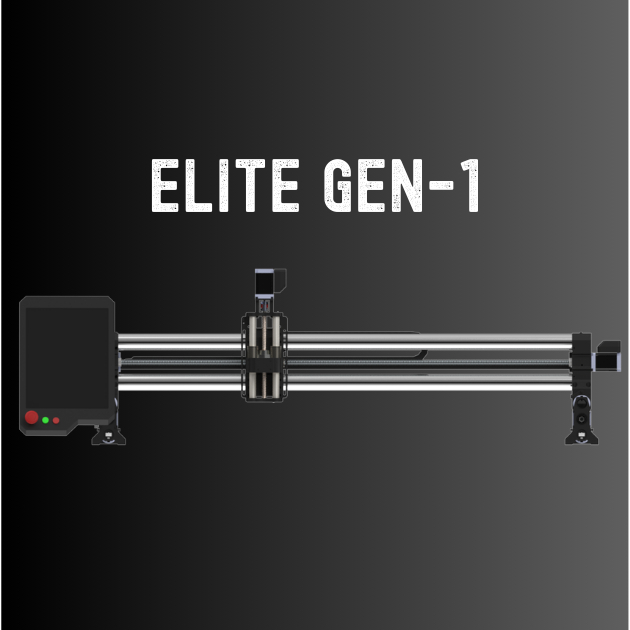
The Onefinity Elite Series (Gen 1) is Onefinity's large-format CNC, sold in three cut areas from one product page: Woodworker at 32in x 32in, Journeyman at 48in x 32in, and Foreman at 48in x 48in. It drives X and Y on a 1616 ball screw (16mm per revolution) and Z on a 1610 ball screw (10mm per revolution), with closed-loop 1.2 Nm stepper motors on every axis riding rigid hardened-steel linear shafts. No router or spindle ships with the machine: it has a built-in auto on/off outlet for a Makita router, or you can add Onefinity's own Redline spindle kit on the 80mm mount option.
Every cut starts with one formula: Feed Rate = Spindle Speed (RPM) x Chip Load x Number of Cutting Edges (flutes). Chip load is the thickness of material each cutting edge removes in one revolution of the bit. This number comes from the manufacturer of the bit, which publishes a chip-load chart for each bit diameter and material. Look up your exact bit and material, start from the middle of the published range, and you have the third number in the formula. The chart below shows the recommended spindle speed for each material and bit type.
The Elite Series (Gen 1) doesn't ship with a spindle of its own: you supply a Makita router or Onefinity's optional Redline spindle, so check that unit's plate for its actual RPM range before you dial in a cut. What Onefinity does build in is real rigidity: closed-loop 1.2 Nm steppers, a 1616 ball screw on X/Y and a 1610 ball screw on Z, all riding hardened-steel linear shafts. A truly rigid machine with a powerful spindle can cut as deep as the bit is wide in a single pass, but that takes real spindle torque, a drive train and clamps that hold firm, a gantry that will not flex, and enough mass to soak up vibration. The Elite Series' ball-screw build gets you most of the way there mechanically, so once you know your spindle's actual power and RPM you can push depth per pass further than on a belt-driven hobby kit. Push too deep for the bit and spindle you have and it will still deflect and chatter, leaving scalloped edges, or rub instead of cutting and burn the material. The fastest way to dial in a cut is to see what has already worked for other people.
Worked example for feed rate: 1/8in (3.175mm) two-flute solid carbide end mill in hard wood. The chart says 16,000 RPM; since the Elite Series doesn't include a spindle, check your own router or spindle's plate for its actual maximum and cap the RPM there if it's lower. With the bit maker's 0.025mm per tooth (0.0010 in): 16,000 x 0.025 x 2 = 800 mm/min (31 in/min) feed. For depth per pass, start shallow and check Community Cut Settings in Easel for what works on this machine. If the cut sounds strained, reduce the depth, not the feed. Slowing the feed below the chip load makes the bit rub instead of cut.
Community Cut Settings shows the spindle speed, feed rate, and depth per pass other makers actually run for your machine, material, and bit.
The Onefinity Elite Series (Gen 1) runs an Onefinity MASSO Touch controller, not GRBL or FluidNC, so Easel's live Driver and Rapid Connect do not connect to it directly. Set up a Non-GRBL Machine Profile for this machine in Easel, design your project as usual, then use Project > Download G-code to save a .nc file. Transfer that file to the MASSO Touch controller over its built-in WiFi using Masso Link, or copy it to a USB flash drive, then run the job from the touchscreen.
Try Easel Free →
Create your free Easel account and connect your machine in minutes.
Easel Free Trial →